Classrooms Without Ceilings: How Darjeeling's Teachers Are Building the Next Generation of Climate Stewards
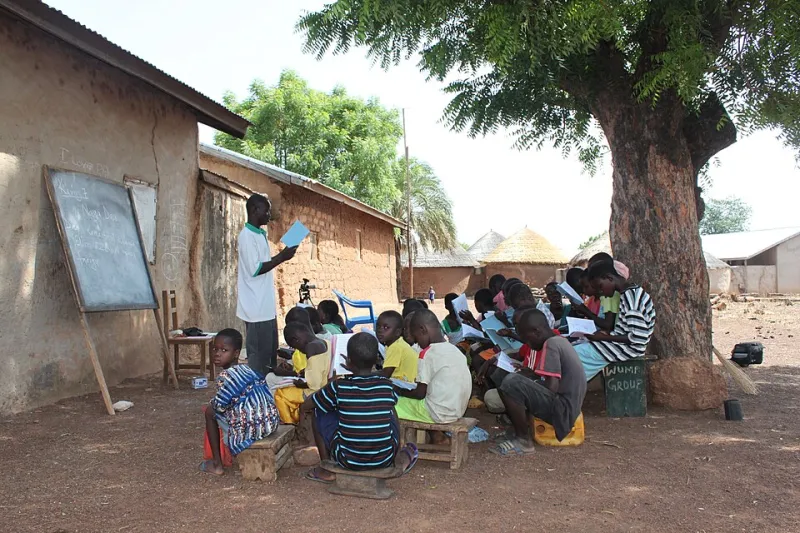
Photo: DFID - UK Department for International Development, CC BY-SA 2.0, via Wikimedia Commons
At an elevation where morning fog erases the horizon and landslides can reshape a hillside overnight, the classroom has long occupied a peculiar position in Darjeeling's communities. It has been simultaneously a refuge from the mountain's unpredictability and a place curiously sealed off from it. That paradox is now dissolving. Across the region's schools, a generation of educators is doing something quietly radical: they are using the climate crisis not as a subject to be feared, but as a curriculum to be taught.
The results are drawing attention far beyond the Himalayas.
When the Environment Becomes the Lesson Plan
In a modest school perched above the Teesta River valley, a science teacher named Priya Tamang has replaced the standard unit on weather systems with a semester-long project she calls "Reading the Ridge." Students spend two mornings each week recording changes in soil moisture, documenting shifts in the local flowering calendar, and interviewing elderly community members about how seasonal patterns have transformed over their lifetimes. The data they collect feeds into a hand-drawn atlas of environmental change that the school updates annually.
"The children are not learning about climate in the abstract," Tamang explains. "They are learning that the mountain has a language, and that it is speaking differently than it did a generation ago."
This approach — rooting environmental education in hyper-local observation rather than generalized scientific principle — is increasingly common across Darjeeling's school network. Teachers are adapting state curricula to incorporate indigenous ecological knowledge, traditional agricultural calendars, and community-based monitoring practices that have existed in the region for centuries. The innovation lies not in rejecting formal science but in anchoring it to the specific, observable world that students inhabit every day.
A Pedagogy Born of Necessity
Darjeeling's educators did not arrive at these methods through academic idealism alone. The region has experienced measurable climate disruption: altered monsoon timing, increased incidence of landslides, erratic snowfall in upper elevations, and accelerating shifts in the conditions that define its celebrated tea-growing terroir. For communities whose livelihoods depend on agricultural predictability, these changes carry immediate economic and social consequences.
Facing this reality, several teachers began to recognize that conventional schooling — which largely treated the environment as backdrop rather than subject — was producing graduates ill-equipped to navigate the landscape they would inherit. The response was pragmatic. If the mountain is changing, then understanding that change must become a core competency, as fundamental as literacy or numeracy.
The Darjeeling Hills' school network, supported by local development organizations, has piloted what practitioners call "climate-responsive teaching," a framework that integrates environmental observation into multiple subject areas simultaneously. A mathematics lesson might involve calculating the volume of water lost when a local spring diminishes. A history class might trace how land use patterns shifted following major weather events in the nineteenth century. An English composition assignment might ask students to write a formal letter to a municipal authority documenting a specific environmental concern they have personally observed.
Living Laboratories and Community Partnerships
Perhaps the most distinctive feature of Darjeeling's approach is the deliberate dissolution of the school's walls. Several institutions have formalized partnerships with local farming families, conservation groups, and watershed management cooperatives, integrating students into ongoing community-level environmental work.
At one school in the Mirik subdivision, students participate in a seasonal reforestation initiative alongside adult community members. They are not simply planting saplings; they are tracking survival rates, analyzing which native species perform best under current moisture conditions, and presenting their findings to the school board at the end of each academic year. The project gives students a sense of genuine agency — the understanding that their observations carry weight and that their actions have measurable consequences.
"We want them to understand that they are not just studying a problem," says one school principal involved in the initiative. "They are part of the solution. That changes how seriously they take the work."
This philosophy has produced some unexpected outcomes. Several student-led environmental monitoring projects have generated data that local agricultural cooperatives have found genuinely useful for planning purposes. In at least one documented case, student observations about changes in a local stream's flow rate prompted early action by community water managers, potentially preventing a more serious disruption to the village's irrigation system.
Lessons for Rural America
The relevance of Darjeeling's experience extends well beyond the Himalayas. Across the American West and Midwest, rural schools are contending with their own climate-related disruptions — prolonged drought, intensifying wildfire seasons, flooding events that reshape agricultural landscapes and community infrastructure. Many rural educators feel the pressure to address these realities in their classrooms but lack frameworks for doing so in ways that feel authentic rather than imported.
Darjeeling's model suggests several transferable principles. First, effective climate education is place-specific. It begins not with global projections but with local observation — the creek that runs lower each summer, the crop varieties that no longer thrive, the weather patterns that older farmers remember differently. Second, it is most powerful when it connects students to community members who hold long-term environmental memory. Third, it treats students as contributors to genuine problem-solving rather than passive recipients of alarming information.
For rural American schools navigating these questions, the mountain school model offers something more valuable than a curriculum guide. It offers a philosophy: that the most urgent environmental education is not the kind that teaches students to worry about the planet, but the kind that teaches them to understand — and act within — the specific landscape they call home.
The Broader Vision
At APS Darjeeling, we recognize that educational innovation of this kind does not emerge in isolation. It requires sustained community investment, institutional support, and the professional development of teachers who are themselves learning to see their environment with new eyes. The educators pioneering these approaches in Darjeeling's mountain schools are doing so largely through their own initiative, often with limited resources and without formal recognition.
Their work deserves wider acknowledgment — not only as a model for the communities they serve, but as a contribution to a global conversation about what education must become in an era of accelerating environmental change. The mountain, it turns out, is an extraordinary teacher. Darjeeling's educators are simply learning to listen to it, and to pass that skill on.