Engineering the Monsoon: How Darjeeling's Problem-Solvers Are Transforming Seasonal Peril Into Lasting Infrastructure
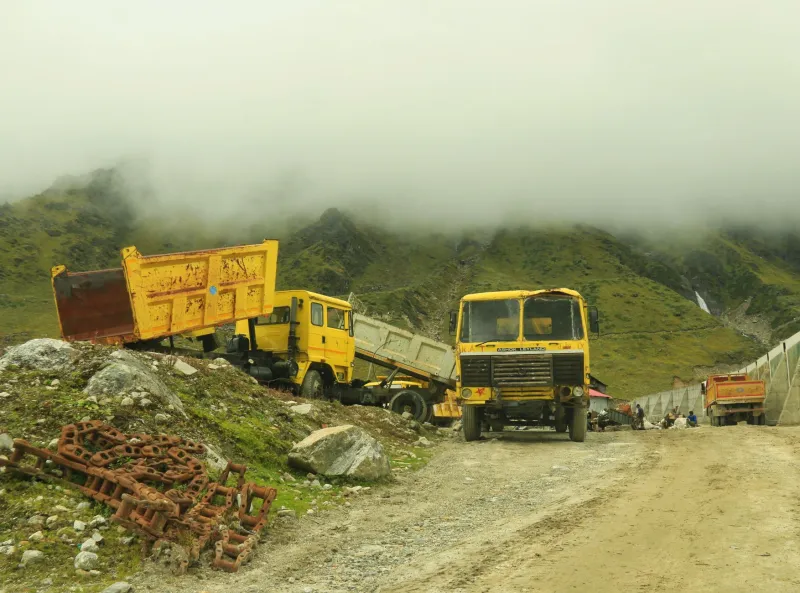
For anyone who has watched a Pacific Northwest hillside give way after a week of November rain, the mechanics of a landslide feel viscerally familiar. Now imagine that scale multiplied across an entire mountain district, repeated every year between June and September, in terrain that rises sharply from subtropical foothills to Himalayan ridgelines. That is the annual reality for Darjeeling's roughly 1.8 million residents—and for decades, it was simply accepted as the price of living at altitude.
That acceptance is eroding. A new generation of civil engineers, hydrologists, and community organizers is treating Darjeeling's monsoon vulnerability not as an immutable condition but as a design problem—one with solutions that may ultimately offer lessons to mountainous communities from the Cascades to the Andes.
The Scale of the Challenge
Darjeeling receives between 100 and 130 inches of rainfall annually, with roughly 80 percent of that total compressed into the June-through-September monsoon window. The district's geology compounds the risk: much of the region sits on highly fractured metamorphic rock overlaid with thin, moisture-saturated soils. When saturation thresholds are crossed—often within a single prolonged storm event—slope failures can occur rapidly and without warning.
The human cost is significant. Road closures regularly sever communities from markets, hospitals, and schools for days or weeks at a stretch. Agricultural terraces, many of them generations old, are periodically destroyed in hours. Drinking water infrastructure, already strained in remote villages, becomes contaminated when landslide debris enters stream channels.
Yet the engineering community working in Darjeeling has increasingly come to view these recurring crises as a data-rich laboratory. Each failure event generates information about soil behavior, drainage patterns, and structural vulnerabilities—information that, if systematically captured, can drive meaningful improvements.
Indigenous Wisdom as Engineering Input
One of the more striking developments in Darjeeling's infrastructure conversation is the formal integration of traditional water management knowledge into contemporary engineering practice. Communities in the region have managed hillside water for centuries, developing what are locally known as naula systems—stone-lined collection channels and subsurface diversion structures that intercept groundwater before it can destabilize slopes.
For much of the twentieth century, these systems were treated as cultural artifacts rather than functional infrastructure. Modern road construction frequently cut across or disrupted them, inadvertently increasing slope instability in ways that weren't fully understood until engineers began mapping the relationship between road corridors and landslide frequency.
Recent collaborative projects between local engineering teams and village councils have reversed that dynamic. In several subdistricts, traditional drainage geometries have been digitally mapped and incorporated into updated slope stabilization plans. The result is a hybrid approach that combines the spatial logic of ancestral systems—often optimized through generations of trial and error—with modern materials such as geotextile reinforcement and engineered aggregate.
For American audiences familiar with the growing interest in Indigenous ecological knowledge within U.S. land management, the parallel is instructive. Just as tribal water stewardship practices are increasingly informing watershed restoration in the American West, Darjeeling's engineers are discovering that local knowledge holds engineering value that formal training alone cannot replicate.
Modular Infrastructure for Fragile Terrain
Another area of active innovation involves rethinking the fundamental design assumptions behind mountain infrastructure. Conventional road and bridge engineering optimizes for permanence—structures are built to last decades with minimal intervention. In a landslide-prone environment, that philosophy creates a vulnerability: when a permanent structure fails, the disruption is severe and the recovery timeline is long.
Several engineering teams operating in Darjeeling have been piloting an alternative model built around modularity and rapid reconfiguration. Prefabricated bridge sections, designed to be assembled and disassembled by small crews without heavy equipment, allow communities to restore critical crossings within days of a washout rather than waiting months for a full reconstruction project to be funded and executed.
Similarly, retaining wall systems using locally sourced stone and interlocking forms—rather than poured concrete—are being tested on secondary road corridors. These structures are less expensive, require no specialized equipment to build, and can be repaired incrementally by community labor teams trained in basic construction techniques. When a section fails, it fails partially rather than catastrophically, and the repair cycle is measured in days rather than seasons.
The modularity principle extends to water management as well. Portable sediment traps and channel liners, deployable at the onset of heavy rainfall events, are being distributed to village-level response teams in higher-risk zones. The goal is to intercept debris flows before they reach critical infrastructure rather than managing the aftermath of each event.
Early Warning as Community Infrastructure
Perhaps the most consequential innovation underway in Darjeeling is the development of community-operated early warning networks. Slope monitoring in high-income countries typically relies on expensive sensor arrays and centralized data systems managed by government agencies. That model is largely inaccessible for Darjeeling's village-scale communities, where budgets are constrained and technical capacity is unevenly distributed.
In response, local technologists have been deploying low-cost sensor packages—combining soil moisture probes, tilt meters, and rainfall gauges—that transmit data via cellular networks to shared dashboards accessible on standard smartphones. Village-level coordinators, trained in a two-day certification program developed collaboratively with a regional engineering college, monitor these dashboards and issue alerts through WhatsApp-based community notification chains.
The system is deliberately designed around the communication infrastructure that already exists rather than requiring communities to adopt new platforms. And because the sensors are inexpensive and locally maintainable, the network can expand incrementally as communities gain confidence in the technology.
Early results from pilot deployments suggest that lead times for community evacuation and infrastructure protection are improving meaningfully—giving residents and road maintenance crews hours of advance notice rather than the zero warning that characterized many past events.
A Model With Global Relevance
The attention Darjeeling's engineering community has attracted from international climate adaptation organizations is not incidental. As climate models project intensifying precipitation events across mountain regions worldwide—from the Hindu Kush to the Rockies to the Alps—the demand for scalable, community-embedded resilience frameworks is growing rapidly.
What Darjeeling offers is not a finished blueprint but something arguably more valuable: a working proof of concept developed under genuine resource constraints, by communities with a direct stake in its success. The hybrid of traditional knowledge, modular design, and accessible technology is precisely the kind of approach that international development organizations have been attempting to theorize for years.
For APS Darjeeling, the significance of this work extends beyond the engineering itself. Infrastructure resilience is the foundation on which every other dimension of community development rests—economic opportunity, educational access, agricultural productivity, and public health all depend on the basic connectivity that roads, bridges, and water systems provide. When communities master the ability to maintain that connectivity in the face of seasonal disruption, they gain something that transcends any single project: the capacity to build continuously, rather than rebuild perpetually.
The monsoon will return next June, as it always does. But increasingly, Darjeeling's communities will meet it as engineers rather than as bystanders.